
- russian
- luganda
- maithili
- maori
- marathi
- norwegian
- oromo
- persian
- polish
- portuguese
- quechua
- korean
- shona
- sindhi
- singapore
- spanish
- tamil
- thai
- turkish
- ukrainian
- urdu
- vietnamese
- english
- arabic
- aymara
- basque
- belarusian
- bengali
- cebuano
- czech
- danish
- deutsch
- dutch
- afrikaans
- filipino
- finnish
- french
- galician
- hindi
- indonesian
- irish
- italian
- japanese

Finding a balance between luxury and budget often feels like a contradiction in interior design, particularly when sourcing high-quality timber. Many property owners assume that achieving a high-end aesthetic requires an exorbitant investment, leading them to settle for synthetic alternatives that lack the depth and longevity of natural wood.
The emergence of specialized sourcing and optimized manufacturing has shifted the market, making discount wood flooring a viable path for those who refuse to compromise on material integrity. By understanding where the value is created—and where the unnecessary costs are hidden—buyers can secure genuine hardwood that enhances property value without overextending their budget.
This analysis explores the technical distinctions between "cheap" and "value-driven" flooring, providing a framework for evaluating structural stability, environmental certifications, and long-term return on investment in the current market.

The Anatomy of Value in Hardwood Sourcing

The term "discount" in the flooring industry is often misunderstood. True value is not found in the lowest price point, but in the reduction of intermediary markups and the optimization of the supply chain. When a manufacturer integrates raw material sourcing with advanced precision engineering, they can offer premium species like Oak, Walnut, and Hickory at a more accessible price.
The difference between a budget product and a value-driven one lies in the technical specifications. While low-end options may use inferior glues or unstable timber, professional-grade options maintain rigorous standards for moisture content and emission levels, ensuring that the cost saving does not result in structural failure or health risks.
Technical Indicators of Flooring Quality
Evaluating hardwood requires looking beyond the surface finish. A primary indicator of quality is the plank thickness and the precision of the milling. For instance, a standard thickness of 18mm to 20mm in solid wood flooring provides the necessary mass for repeated sanding and refinishing over several decades, which is a critical factor in long-term value retention.
Surface treatments also play a pivotal role in durability. High-performance UV matt oils or natural hardwax oils are preferred over generic lacquers because they penetrate the wood fibers, providing robust scratch resistance while allowing the wood to "breathe." This prevents the brittle cracking often seen in cheaper, surface-only coatings.
Furthermore, environmental safety is no longer optional. Compliance with NAF (No Added Formaldehyde) and CARB/EPA standards ensures that the flooring does not off-gas volatile organic compounds (VOCs). This technical requirement is essential for maintaining indoor air quality, particularly in children's rooms or high-occupancy commercial settings.
Stability and the Kiln-Drying Process
The most significant risk associated with natural wood is dimensional instability—the tendency of planks to warp, cup, or crack due to changes in humidity. The only professional solution to this is a rigorous, multi-stage progressive kiln-drying process.
Achieving a precise moisture content of 6% to 8% through stress-relief groove technology is the technical benchmark that separates generational flooring from short-term installations.
When this level of precision is combined with high-solid polyurethane UV coatings, the result is a floor that resists seasonal movement. This engineering allows the wood to maintain its integrity across diverse climates, reducing the likelihood of gap formation or buckling.
Comparing Material Lifecycle Performance
When calculating the cost of flooring, the initial purchase price is only one variable. The true cost is the "cost per year of service." Standard synthetic or low-grade flooring often requires full replacement every 10 to 15 years, whereas premium solid hardwood can last over 50 years.
This longevity is driven by the ability to refinish the surface. By sanding away wear and applying a new coat of oil or lacquer, the flooring is effectively reset to its original state, eliminating the need for costly demolition and re-installation.
Figure 2. Comparative Value Index by Flooring Type
Strategic Application in Residential and Commercial Spaces
The choice of installation system often depends on the specific use case. Click Lock systems are ideal for residential renovations where speed and ease of replacement are priorities. In contrast, Traditional Tongue & Groove installations are the gold standard for high-end architectural projects and prestige commercial spaces, offering a more seamless and permanent fit.
For boutique hotels or luxury retail stores, the focus shifts toward wear resistance. The application of high-solid polyurethane coatings provides the necessary protection against heavy foot traffic while maintaining the organic warmth of natural wood. This allows commercial operators to achieve a luxury aesthetic without the fragility typically associated with natural timber.
Sustainable Trends in Timber Manufacturing
The modern flooring industry is moving toward a "closed-loop" sustainability model. Sourcing from FSC and PEFC certified forests is no longer a niche preference but a baseline requirement for global distribution. This ensures that the timber used in discount wood flooring does not contribute to deforestation.
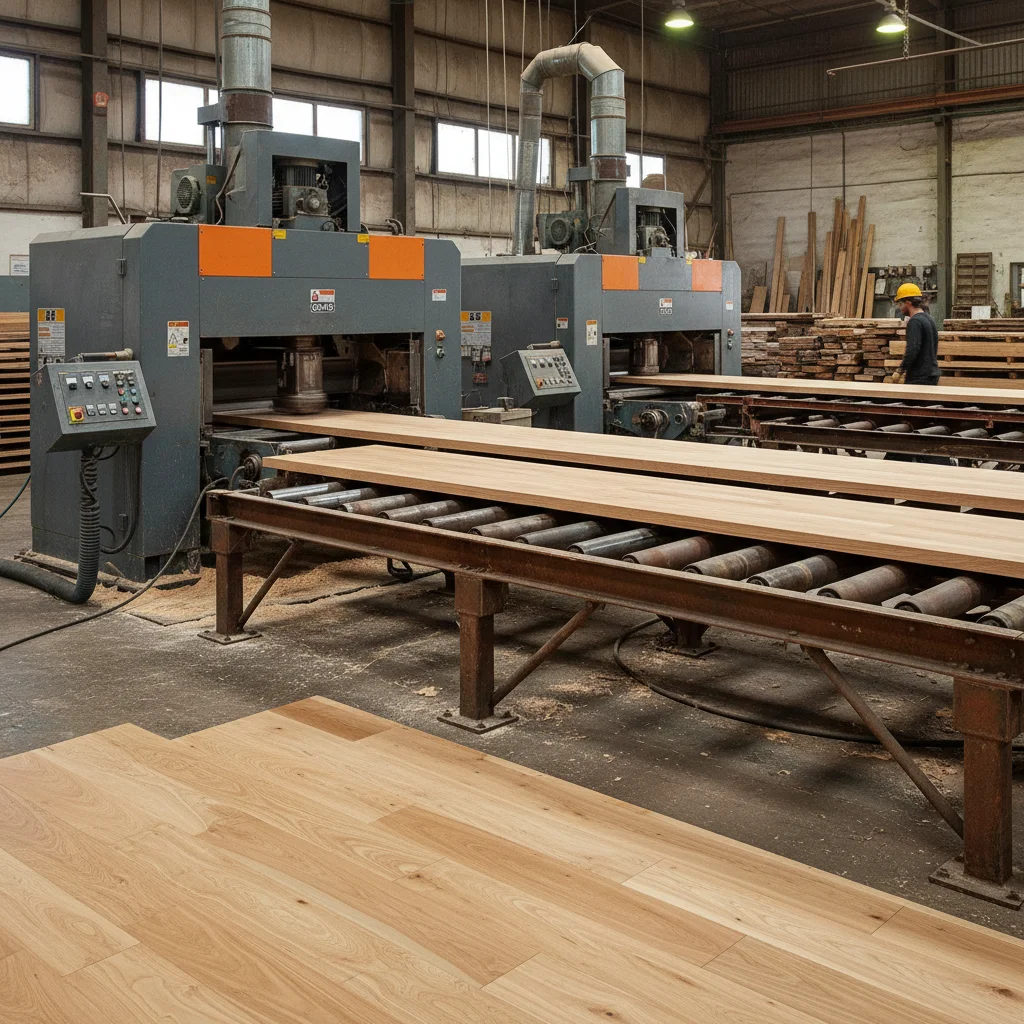
Technological innovation is also reducing waste during the manufacturing process. Advanced German-engineered equipment from brands like Weinig and Leuco allows for higher precision in cutting and milling, which minimizes raw material scrap and lowers the overall cost per unit.
Furthermore, the shift toward low-VOC and formaldehyde-free adhesives is reflecting a broader global trend toward health-centric building materials. Flooring is now viewed as a component of the indoor environment that can help regulate humidity and improve overall well-being.
Decision Framework for Procurement
Selecting the right flooring requires a systematic comparison of technical trade-offs. Buyers must decide between the immediate cost savings of synthetic materials and the long-term asset appreciation provided by natural hardwood.
A key consideration is the intended lifespan of the project. For short-term rental properties, a cost-effective laminate may suffice. However, for owner-occupied homes or prestige corporate offices, the investment in solid wood is justified by the significant increase in property valuation.
The following framework outlines the relative suitability of different flooring options based on key performance indicators, helping procurement officers and homeowners make an informed choice.
| Evaluation Factor | Standard Laminate | SPC Flooring | Premium Solid Wood | Relative Suitability |
|---|---|---|---|---|
| Expected Lifespan | 10-15 Years | 15-20 Years | 50+ Years | Hardwood (High) |
| Property Value Impact | Neutral | Low Positive | Significant Increase | Hardwood (High) |
| Maintenance Requirement | Replacement Only | Low / Replacement | Refinishable | Hardwood (Sustainable) |
| Environmental Health | Variable VOCs | Moderate | Eco-Friendly/NAF | Hardwood (High) |
| Installation Speed | Fast (Click) | Fast (Click) | Moderate to Slow | Laminate/SPC (High) |
| Aesthetic ROI | Generic | Modern/Clean | Exclusive Luxury | Hardwood (High) |
Questions & Answers
In a professional context, "discount" refers to value-engineering and supply chain optimization rather than a reduction in material quality. By sourcing directly from manufacturers who control the process from raw timber selection to final UV coating, buyers can avoid retail markups. This allows access to premium species like Oak or Walnut at a lower price point without sacrificing technical standards like moisture content (6%-8%) or eco-certifications (CARB/EPA).
Solid wood flooring is generally viewed as a permanent asset rather than a consumable finish. While SPC (Stone Plastic Composite) is durable and waterproof, it does not add significant equity to a home. Premium hardwood, conversely, is highly coveted in the real estate market. Because it can be sanded and refinished multiple times, it offers a generational lifespan, which significantly increases the overall market appeal and valuation of a luxury residential or commercial property.
Yes, provided the flooring is treated with high-performance finishes. The use of high-solid polyurethane UV coatings or deep-penetrating hardwax oils provides the necessary scratch and stain resistance required for boutique hotels, corporate lobbies, and retail stores. When paired with a thickness of 18mm or 20mm, the floor can withstand years of heavy use and be professionally restored to its original condition without requiring full replacement.
The primary risks are dimensional instability and health hazards. Low-cost flooring often skips the multi-stage progressive kiln-drying process, leading to warping or cracking when humidity changes. Additionally, "cheap" products often utilize adhesives containing high levels of formaldehyde. Professional-grade value flooring mitigates these risks through precision drying and NAF (No Added Formaldehyde) certifications, ensuring a safe and stable installation.
Traditional Tongue & Groove is often considered more sustainable for high-end, permanent projects because it creates a seamless, rigid structure that lasts for decades. While Click Lock is faster and easier to install (and better for DIY or temporary setups), the Traditional method is preferred for luxury architectural projects where the goal is a lifelong installation that integrates fully with the building's structure.
Sustainability and durability are closely linked through forest management. Timber sourced from FSC or PEFC certified forests is typically harvested at the optimal maturity of the tree, which ensures a denser grain and better natural stability. When this high-quality raw material is processed using precision German-engineered equipment, the resulting flooring possesses superior structural integrity compared to wood sourced from unmanaged or rapidly harvested forests.
Final Thoughts
The transition toward value-driven procurement in the flooring industry allows property owners to secure the prestige of natural hardwood without the traditional price barriers. By focusing on technical benchmarks—such as a 6%-8% moisture content, NAF compliance, and sustainable FSC sourcing—buyers can ensure that their investment provides both immediate aesthetic luxury and long-term financial return.
Ultimately, the goal is to shift the perspective from the initial cost of installation to the total cost of ownership. In this framework, premium solid wood flooring emerges not as a luxury expense, but as a strategic asset that enhances the environment and preserves property value for generations.



Ethan Reynolds
If you are interested in our products, you can choose to leave your information here, and we will be in touch with you shortly.


